Supporting early writing through physical development in the EYFS
Physical development: the foundation of early writing
Physical development plays a foundational role in early childhood learning, and within the Early Years Foundation Stage (EYFS), it is closely linked to children’s ability to develop writing skills. While writing is often thought of as a purely cognitive or literacy-based activity, the transcriptional dimension is in fact deeply rooted in physical competence. Before a child can successfully form letters or control a pencil, they must first build the strength, coordination, and motor control that underpin these actions.
Why movement matters for writing in the EYFS
As a prime area of learning and development, this emphasises its importance not only for general health and wellbeing but also for enabling progress across other areas, including, and particularly, literacy. Writing relies heavily on both gross and fine motor skills.
Gross motor development - such as running, climbing, and balancing - helps children build core strength, stability, and posture. These are essential for maintaining control over hand movements. Without this stability, children may tire quickly or struggle to coordinate their actions when attempting to write.
From big movements to pencil control
Fine motor skills are even more directly linked to writing. These involve the small muscles in the hands, fingers, and wrists. Activities such as threading beads, using scissors, building with small blocks, or manipulating playdough all contribute to strengthening these muscles and improving dexterity. Through such experiences, children learn to control their hand movements with increasing precision, which is crucial for holding a pencil correctly and forming letters.
Another key aspect of physical development is hand-eye coordination. Writing requires children to visually track what they are doing while simultaneously controlling their hand movements.
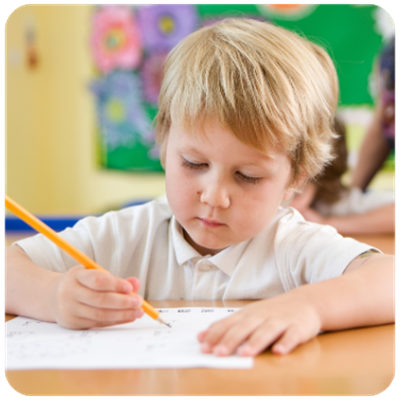
This coordination develops gradually through activities like drawing, painting, or even simple tasks such as pouring and filling containers. These experiences help children make the connection between what they see and how they move, a skill that becomes essential when they begin to write.
Building writing skills through hands‑on play
It is also important to consider the role of proprioception (often called the "sixth sense") and spatial awareness. Children need to understand where their body is in space and how much pressure to apply when using a writing tool. Without this awareness, they may press too hard or too lightly, leading to frustration and reduced confidence. Activities that involve pushing, pulling, climbing, or carrying objects can support the development of these sensory skills.
Crucially, the EYFS emphasises how a critical aspect of learning occurs through self-directed and autonomous activities, and this is particularly relevant for physical development. Writing should not be introduced in isolation or too early, before children are physically ready. Instead, practitioners should provide a rich environment filled with opportunities for movement, exploration, and hands-on activities.
Mark‑making: where writing really begins
Mark-making (such as drawing lines, circles, and patterns) is an important bridge between physical development and formal writing. It allows children to experiment with tools and movements in a low-pressure way, gradually building the skills they need.
Creating confident writers from the start
In conclusion, physical development underpins writing in profound and often underestimated ways. By prioritising movement, strength, coordination, and fine motor control in the early years, educators can lay the groundwork for successful writing. When children are physically prepared, they are more likely to approach writing with confidence, enjoyment, and a readiness to learn.
Deepen your practice with our Writing in Action CPD event
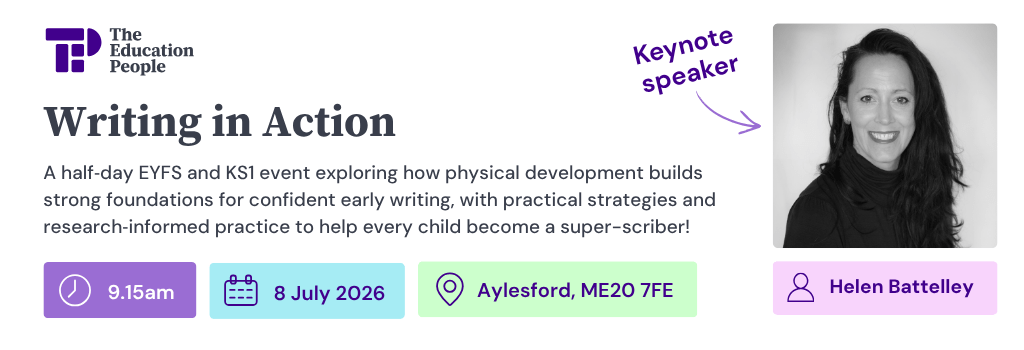
To explore this in practice, join us on Wednesday 8 July for Writing in Action, a half‑day event for EYFS, KS1 and English leaders focused on building strong foundations for writing. Led by Helen Battelley (Music + Movement), the session highlights the vital role of physical development in creating confident early writers and shares practical strategies to strengthen writing provision from the start.
About the author
Jan Dubiel - Improvement Adviser